Showing posts with label costume. Show all posts

Monday, February 24, 2014

1840's Bonnet

I don't call myself a Milliner. I call myself a Costume Specialist. Or a dressmaker, if it needs explanation. But lately, I've been a milliner. It seems the costume work coming my way has got smaller, juts like the budgets at Canada's historic sites. Sigh. What can you do? Our  government doesn't value our history.

Anyway, here's my bonnet. It's an 1840's poke bonnet. It presented a few challenges. First, I had a sample - always good. But (there's always a but) it was going to be the same, but different! Let's add a wire brim and change the interfacing and then the fabric...You get the idea.

The new fabric was a moire. It wasn't easy to hand sew, so adding the bound edge was a test for the fingers. I had to use a pair of pliers to pull the needle through.

I'm quite pleased with it. I had fun trimming it. The ribbon is vintage rayon, made in Paris. It came wrapped in delightful brown paper. The feather and roses work well. I have some white flowers I could use, but I'm not sure. One always has to think about who will use it and how it will be taken care of. I've seen a few sad sights, I can tell you. 

What do you think? Ready for an afternoon promenade?

Wednesday, December 4, 2013

Whimsical Elegance


Helen Cohen has spent over 40 years in the doll world, beginning with rag dolls and progressing through miniatures, owning her own shop and then onto the larger figures represented in this book. This wonderful combination of cats with the human form in fabulous historic costume “takes the viewer to a different philosophical dimension.”  Why cats? You may ask yourself. Once you see them, you’ll ask “why not?” It certainly works!


Lavish, sumptuous, gorgeous are all words I used when admiring the dolls on my first glance through the book. The figures range in size from 4 1/2” to 22” Tiny companion figures of cats and dogs are as equally detailed as the main characters. Cohen uses resin cat faces for her figures, which are purchased and then painted over. Using her extensive self-taught costuming skill is clearly what she enjoys the most. No sewing machines were used to create all the amazing designs, the costumes being permanently attached to the figures. Accurately representing many historical periods, Cohen takes us on a walk through time. While not being a strictly how-to book, much detail is provided on each doll. They are described in great detail, giving us references to the period or character represented and her thinking on the process. Departures into fantasy are also noted, to clarify when a costume is not strictly period.


The photography by David Gehosky is superb. With experience photographing historic costume for museums and publications, his talent brings the work to us in eye popping clarity. The detail shots and camera angles are the essence of the whole presentation of this book.


Anyone who enjoys dolls or costume will appreciate this book, which I highly recommend.
 
Available from Schiffer Publishing and Amazon


Friday, July 26, 2013

Crank

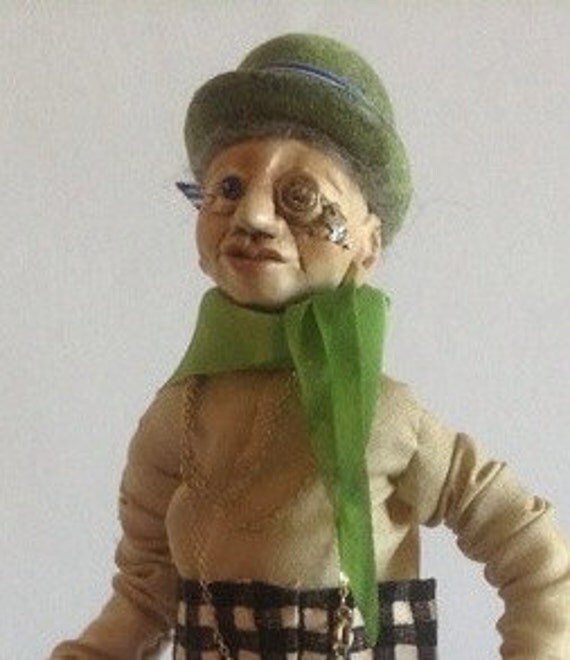
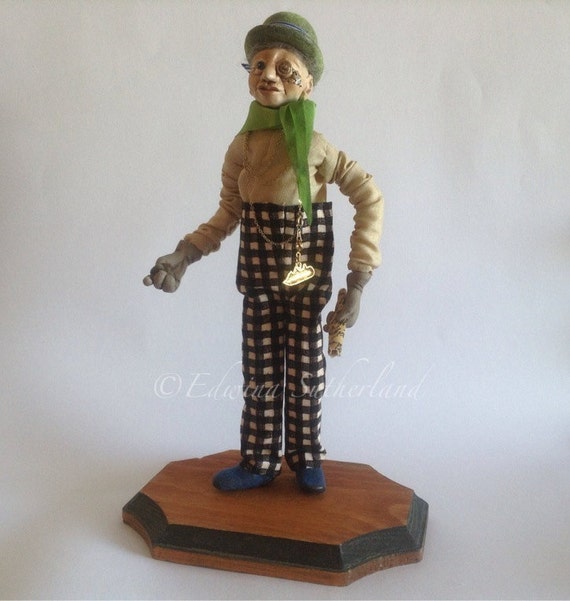
Meet Crank. I finished him for the show I did last weekend. He didn't sell, so he's now for sale in my Etsy store. The show was a bust as far as sales go, even though I had fun wearing my steampunk costume and hanging out with Choleena.


This guy is small, almost 11", with the base. He has polymer clay head, hands and feet. I used flocking to add texture to his hat and shoes. I wanted that true eccentric/ mad scientist look. His pants are too big, he has altered himself with a mechanical eye. He's a crank, so look out! 

Friday, May 10, 2013

Corsets and stays

You know I'm crazy for corsets. At Williamsburg, I got to see planty being worn.

This week, I saw an online article about using zip ties as boning. these babies, however, are works of handsewn art. No machine sewing at all!


Friday, July 20, 2012

Creating Historic Costuming for Art Dolls


Annabelle cloth art doll by Edwina Sutherland

Creating Historic Costuming for Art Dolls

Sometimes we start a project with grand ambitions to do it right. Once you’ve decided to dress a doll in historic costume you have decisions to make: what era am I depicting, how accurate am I going to get with the costuming? I’ll walk you through my approach and tell you some of the tricks and tips I use.
You can have a lot of fun with a project like this; there will be many questions to answer. I start by researching the era. Once I have found the look I want in one of my books, I look for the pattern shapes. These are the best way to get an authentic cut for a costume, no matter what size it is. Evolution of Fashion: Pattern and Cut from 1066 to 1930by Margaret Hamilton Hill and Peter Bucknell, or Patterns of Fashion by Janet Arnold are both excellent resources.
Pattern making
Now I fold and pin a pattern on the doll. You can use paper towel for this or soft interfacing. I lay it over the doll’s body and mark it with the period patterns in mind. Certain things, like the placement of the grain lines on the skirt panels are very important to give the authentic look.
1885 skirtpattern by Edwian Sutherland
An 1860 -1885 skirt, for example has several panels, with the straight of grain on the front edge of each panel. This has the effect of pushing the fullness of the skirt back, adding to the bustle effect.
1850 costume art doll Edwina Sutherland
1850 costume art doll edwinadolls.com
The right fabric
Using the right fabric is important. Heavy fabrics won’t pleat or gather softly and be much too heavy at the waist. A trick I use here is to make the doll’s waist small, so that it can accommodate a pleated or gathered skirt, without losing the dolls’ waistline. Fabric can also be edited out of the top of the skirt to reduce bulk. If the bodice will cover the waist, don’t bother with a band at the skirt waist, just stitch the pleats or gathers flat and then lay the bodice over it.

Simplify construction
Seams can be eliminated to simplify the construction.
General Brock art doll by Edwina Sutherland
This soldier’s coat should have side seams and side back seams. I have eliminated them here without losing the effect of the era. This 1812 coat has facings sewn with raw edges. Accurate for the period, it meant using a fabric that wouldn’t fray.
Generals coat pattern layout by Edwina Sutherland
I was puzzling over the trim for this general’s jacket. The portraits I was studying showed elaborate braid across the fronts. Further research showed a jacket at a museum, without any braid. So I can be accurate and simplify the costume at the same time! The bicorn hat was created by studying an actual hat. I happen to own one I found at a charity shop, but a museum visit would be useful here too.

Fake it!
Other ways to simplify costuming is to fake it. The Marquis here has a lovely vest.
Marquis coat art doll by Edwina Sutherland
It is only the front, however. I lined and then sewed the fronts closed down the center, added buttons and stitched it to the insides of the coat. There’s no shirt either, just a strip of cloth to simulate the shirt and neckerchief. I used very soft cheesecloth for this. The lace cuffs are sewn to the ends of the sleeves.
So you see that you can create an authentic looking costume, using a few shortcuts to simplify construction. It’s all about researching the cut of the clothing, then choosing appropriate fabrics for the scale, then deciding which parts of the costume can be simplified to make the whole thing work. I wish you success with your next project.

Friday, December 9, 2011

Monday, October 24, 2011

Costume excellence

I have to share this video with you. A fine example of the lost needle arts.

Friday, October 8, 2010

Learning online - Yvette, a period costume doll


This online class started last Friday. I am walking the students through the process of creating a free standing cloth doll, then costuming it in late 18th century style.

The transition from correct period costuming to a dolls' costume is an interesting one. Scale is very important. While keeping the lines of the original garments, they need to be simplified to make construction possible in the scale.

One place I did this was on the short gown. I eliminated the sleeve seams, which would have created bulk. I also faked the chemise and lace cuffs, which would have been part of the chemise sleeves.

Yvette is 16" tall and wears a corset, short gown and petticoat. She also wears bloomers. Strictly speaking, not accurate for the time. So why put bloomers? Because people always peek under the skirts to see if there is underwear. I kid you not! They do! To them, the doll is not complete unless she has underwear. So, modesty is another reason to add bloomers. The lace on the cuffs also helps the skirt stand out. So there's a practical reason, too.

The beauty of online learning is the teacher (me) is there to answer your questions, just like a live class.

The class started last Friday. It's a work at your own pace class, so no worries, you can still join in. Sign up at Doll Street Dreamers Creative College.